Cato's Leaflet Campaign
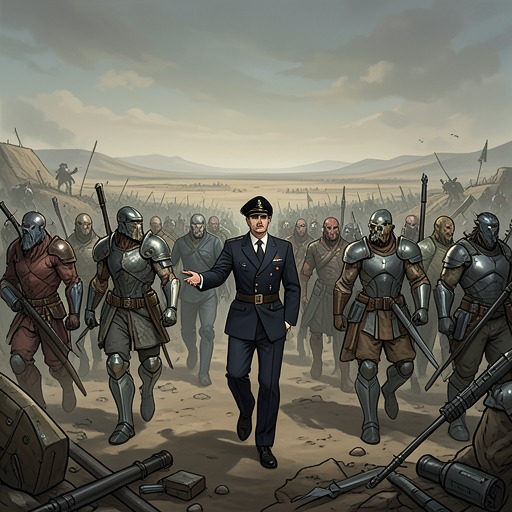
Systema Delenda EstCato's Leaflet Campaign is the deliberate propaganda phase of Cato's war against the System. After the disappearance of the Sydean Lineage created both a possible opening and an immediate intelligence threat, Cato decided that military expansion alone was insufficient. He began distributing leaflets across worlds already familiar with his presence, using words and pictures to undermine reflexive loyalty to the System, weaken opposition to the Crusade quest, and make the population imagine a transition in which the System could disappear without ordinary life collapsing.
Causes and Strategic Purpose
Cato's campaign emerged from a dangerous reversal in his broader struggle. Initik's potential support promised access to intelligence and influence, but that support lay years in the future, while the Sydean Lineage might already have revealed enough of Cato's secrets to System-aligned powers. Cato therefore wanted to act before the System-gods could turn that information against him. A large military campaign would have exposed how deeply he was established, whereas propaganda could advance his cause while he continued spreading through the System.
The leaflets also answered a central problem in Cato's political position. His declared objective was not merely to seize territory but to remove the System itself, which he identified as the force assigning quests, imposing essence costs, and destroying worlds. He had already described its structure as a game that inhabitants were forced to play without any possibility of winning, and his stated answer was to overturn the board. The campaign translated that argument from a private confrontation into a message intended for entire populations.
Cato did not regard propaganda as an alternative to preparation. His expansion depended on exponential growth: industrial bases on hundreds of worlds produced factories, mines, refineries, solar panels, weapons, and remotely manufactured military bodies. Yet the larger his campaign became, the more necessary it was to influence the people living inside those worlds. He wanted them to see the System as an imposed political order rather than as the only imaginable source of meaning, advancement, and security.
The Leaflet Drop
Cato began with worlds whose populations already knew of him and whose forces had been permitted to defeat his armies during an annexation incident. This limited test allowed him to measure public reaction without revealing the full depth of his presence elsewhere. His method was gradual and deliberately cumulative: he intended to repeat the drops for years, slowly changing the political atmosphere rather than expecting one delivery to produce immediate conversion.
On each selected world, mass drivers were retasked to launch small packages into the atmosphere. The bundles were light enough for aerobraking to slow them, and when the air became dense enough, the packing foam collapsed and simple mechanical fastenings released the papers. Cato had designed the leaflets to be fragile and to degrade quickly, a practical measure given the enormous quantity distributed. Thousands were dropped over every city and town, and even over every dungeon on each planet, extending the campaign beyond ordinary civic spaces into locations governed by the System's quest economy.
The descent itself became a spectacle. Hidden Lineages disguised as Coppers or Silvers broadcast images of the papers floating down like strange snow. Some inhabitants assumed the falling bundles were another attack and used fire bolts or whips of water against them. These defensive reactions demonstrated the degree to which the System had trained people to interpret unexplained events through hostility and quest logic. Because the papers were not enemies, ordinary Skills were poorly suited to destroying them without significant collateral damage, allowing the message to remain visible long enough for curiosity to overcome panic.
Message and Public Response
Cato's objective was not to make every reader accept his claims immediately. He expected few people to believe his proclamations outright. The more modest and more consequential aim was to sow doubt: doubt about the System's benevolence, doubt about the necessity of the Crusade, and doubt about the assumption that Cato was simply an external destroyer attacking innocent worlds. Printed words and pictures could create hesitation where direct military action would only produce fear or obedience.
That distinction mattered to Cato because he did not want the transition to be driven solely by terror. He had seen how the System used rewards, essence, quests, and even the pleasurable sensation of completing objectives to shape behavior. In his view, the System's apparent direction and motivation were not neutral gifts but mechanisms that made compliance feel natural. Muar's reaction provides the opposing interpretation: after experiencing System-less space as a silent void without status, purpose, or a way to understand progress, Muar concluded that the System supplied direction, reward, and meaning. The leaflet campaign challenged precisely this psychological dependence by asking inhabitants to imagine that purpose and order might exist outside the System's control.
Cato also understood that reassurance was politically necessary. Fear among ordinary Copper and Silver inhabitants was not his goal, especially when they were simply trying to live their lives. He believed that guarantees of continuity concerning law, property, hearth and home, food, and drink could reduce unrest, but only if he could actually provide them. His propaganda therefore functioned as a promise of managed transition as much as an attack on the System. The campaign sought to separate the fate of the System from the fate of the people living under it.
The response was uneven. Some inhabitants attacked the papers, while others withdrew in fear. Once it became clear that the falling objects contained only words and pictures, the immediate alarm diminished, but the political conflict sharpened. Divine users reacted as true believers rather than as neutral observers. A Bismuth paladin denounced Cato's material as lies in a town square, urging people not even to consider it, and the opposition of System-aligned religious figures gave the campaign a recognizable counter-propaganda front.
Political and Ethical Stakes
The campaign exposes the contradiction at the heart of Cato's liberation project. He opposes the System because it removes meaningful choice, makes killing pleasurable through reward, compels behavior through quests, and destroys entire planets. Yet defeating it requires him to shape public belief, control industrial production, distribute information, and eventually determine who may command dangerous technologies. Cato recognizes that a campaign against domination can itself create a new concentration of authority.
This problem becomes explicit when Cato admits that removing the System and its hierarchy would leave him responsible for creating a replacement. He does not want to decide who governs planets and people, but he also refuses to hand railguns, retroviral engineering, or digitization technology to high-ranking System psychopaths merely to avoid becoming an arbiter. The leaflet campaign is consequently part of a larger attempt to build consent before the old order is destroyed. It is softer than bombardment, but it is still an instrument of power, and its success would make Cato the architect of a political transition he claims to be undertaking for the sake of freedom.
His stated willingness to preserve people and things gives the campaign a moral boundary, but not a simple one. Cato knows that other humans may stand between him and the System. He hopes they can be convinced to stop fighting if enough of the System is cut away and enough threat is demonstrated; nevertheless, he accepts that he may have to fight them if they remain armed obstacles to the System's removal. The leaflets are therefore an effort to prevent that conflict by changing minds before weapons are drawn, not evidence that Cato has abandoned coercion altogether.
Consequences and Significance
The immediate result of Cato's Leaflet Campaign is uncertainty rather than conversion. The papers do not overthrow the System, persuade the divine users, or end the Crusade. Their importance lies in their repeatability and reach. Cato can continue dropping propaganda for years, allowing a slow accumulation of doubt across populations that have been taught to treat the System's rules as reality itself.
The action also marks a change in the scale of Cato's resistance. His original declaration that the System must be destroyed becomes, through the leaflet campaign, a struggle over interpretation: whether the System is a source of truth or an engine of dependency, whether Cato is a marauder or a liberator, and whether life after the System would be meaningless emptiness or a difficult form of freedom. The campaign's fragile papers thus accompany an industrial and military expansion of immense scale, creating a deliberate contrast between the machinery capable of conquering worlds and the small, vulnerable objects intended to persuade their inhabitants.
Its deepest significance is that Cato begins treating political legitimacy as another battlefield. Factories and weapons can seize territory, but they cannot by themselves guarantee that the population will accept what follows. By dropping words and pictures over cities, towns, and dungeons, Cato tries to make the System's authority contestable before its infrastructure is removed. The campaign is a slow attack on the habits of thought that keep the System intact, and its unresolved tension remains central: liberation requires Cato not only to destroy an oppressive order, but also to persuade its subjects that they can survive without it.